


What Are You Carrying That No Longer Serves You and What Should You Keep Change or Release

Autumn has a quiet way of telling the truth.
Leaves change colour, loosen their grip, and fall. The tree does not panic. It does not apologise for releasing what can no longer travel with it into the next season. It simply makes room.
People need that room too.
Many of us carry things long after they stop supporting us. A commitment we said yes to three years ago. A role we outgrew. A thought pattern that once protected us but now keeps us small. A habit that started as comfort and became automatic. An expectation we inherited but never chose.
This is not about judging your past choices. Most things we carry made sense at some point. They helped you belong, survive, achieve, protect, please, build, or cope. The question is whether they still serve the life you are trying to live now.
IAM NUBIA’s Mental Wealth Systems are built around this kind of self-awareness. Mental wealth is not about forcing constant positivity or pushing through at any cost. It is about learning how to notice what is happening inside you, lead yourself with clarity, and make deliberate decisions before burnout becomes the signal that something has to change.
This week’s Autumn theme is simple: What are you carrying that no longer serves you?

Why we keep carrying what feels heavy
People rarely hold on because they lack wisdom. More often, they hold on because the thing they are carrying has become familiar.
Familiarity can feel safe, even when it is draining.
You may keep saying yes because people expect you to be available. You may keep overthinking because it gives you a temporary sense of control. You may keep doing everything yourself because asking for help feels uncomfortable. You may keep a habit because it belongs to an older version of your life, even though your needs have changed.
There is also the quiet pressure of identity.
If you have always been “the reliable one”, rest can feel like failure. If you have always been “the strong one”, honesty can feel risky. If you have always been “the achiever”, slowing down can feel like you are falling behind.
These patterns are not personal flaws. They are signals. They show where your nervous system, your values, your responsibilities, and your environment may be asking for review.
A healthy review does not require shame. It requires attention.
Autumn gives us a useful metaphor because it does not rush the process. Change happens in stages. The leaf shifts colour before it falls. The air cools before the season turns. In the same way, you can begin by noticing what feels heavy before making any big decision.
The difference between full, stretched, and overloaded
A full life can still feel meaningful. A stretched life may need adjustment. An overloaded life often asks for boundaries.
The difference matters.
A full season might include many responsibilities, but they connect to your values. You may feel tired at times, yet there is still a sense of purpose. You can recover. You can breathe. You can see why the effort matters.
A stretched season feels more difficult. You may still be functioning, but your margin is thin. Small changes feel bigger than they should. You may notice more irritability, forgetfulness, procrastination, or emotional distance. These are everyday signals that your current load may need attention.
An overloaded season is different again. You may feel like everything is urgent, even when it is not. You may move through the day reacting instead of choosing. You may resent commitments you once cared about. You may feel disconnected from your own needs.
This article does not diagnose or treat stress, and it is not healthcare advice. It is an invitation to pause and review what you are carrying so you can make more conscious choices.
Here are some common things people carry past their usefulness:
Outdated commitments that no longer match current capacity
Thought patterns built around fear, guilt, or perfection
Habits that drain energy instead of restoring it
Expectations taken on from family, culture, work, or community
Obligations accepted before better boundaries were in place
Roles that leave little space for growth or rest
Routines that continue only because nobody has questioned them
The goal is not to release everything. Some things are worth keeping. Some need care and adjustment. Some need to be put down.
That is where the audit begins.

The Keep • Change • Release Audit
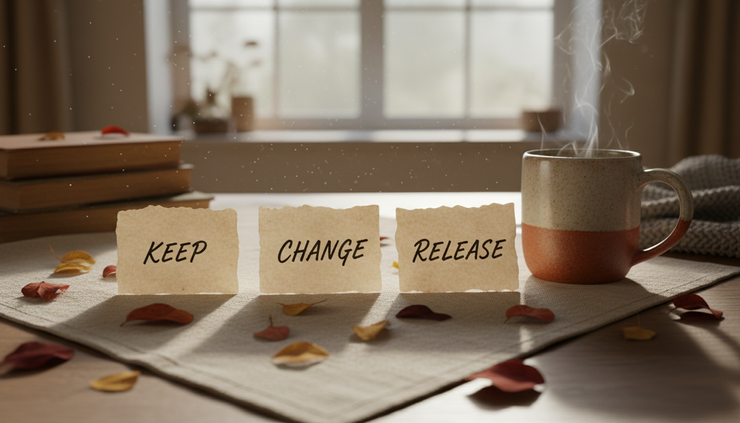
The Keep • Change • Release Audit is a practical framework for reviewing your commitments, patterns, habits, expectations, and obligations.
You can use it at the start of a month, before a busy season, after a major life change, or any time you feel mentally crowded.
You do not need special tools. A notebook, a notes app, or a quiet conversation with yourself is enough.
Set aside 20 to 30 minutes if you can. If that feels like too much, take 10 minutes. The value is not in making the exercise perfect. The value is in making your inner load visible.
Step 1. Name what you are carrying
Start by making a simple list. Do not edit it yet.
Write down anything that takes your time, energy, attention, or emotional space.
Include visible responsibilities, such as:
Work tasks
Family duties
Community roles
Home responsibilities
Financial admin
Health routines
Messages to answer
Errands and appointments
Then include the less visible load, such as:
Trying not to disappoint people
Feeling responsible for everyone’s mood
Replaying old conversations
Comparing your pace to someone else’s
Holding yourself to unrealistic standards
Saying yes before checking your capacity
Expecting yourself to be available all the time
This step can feel revealing. Many people realise their calendar does not show the full truth of what they carry.
Step 2. Ask what is working
Now look at your list and ask:
What is working?
These are the things that still support your wellbeing, values, growth, relationships, or responsibilities.
A commitment may be demanding and still worth keeping. Parenting, caregiving, study, leadership, creative work, or building something meaningful may require effort. The question is not whether it is easy. The question is whether it still belongs in your life in its current form.
Mark these items as `Keep`.
Examples might include:
A morning walk that helps you start the day with steadiness
A weekly family meal that keeps connection alive
A project that stretches you in a meaningful way
A boundary that has reduced unnecessary pressure
A friendship where care moves both ways
Keeping something is an intentional choice. It says, “This still matters, and I choose to continue.”
Step 3. Ask what needs to change
Next, ask:
What needs to change?
Some things do not need to be released. They need a clearer structure, a better boundary, or a more honest agreement.
Mark these items as `Change`.
This category matters because many people treat life like there are only two options: endure or quit. Often, there is a middle path.
A commitment may need a new time limit. A role may need clearer expectations. A habit may need a smaller version. A relationship may need more direct communication. A routine may need to fit the season you are actually in, not the season you wish you were in.
For example:
Instead of answering messages at all hours, set a reply window.
Instead of volunteering every week, move to once a month.
Instead of trying to exercise for an hour, begin with 10 minutes of movement.
Instead of carrying silent resentment, ask for a shared plan.
Instead of saying yes immediately, pause and check your capacity.
Change is often where deliberate growth lives. It helps you stay connected to what matters without abandoning yourself.
Step 4. Ask what you are continuing simply because you are used to it
Now ask the question that often brings the most clarity:
What am I continuing simply because I am used to it?
This is the heart of release.
Some commitments remain only because they have been around for a long time. Some expectations stay because no one challenged them. Some patterns continue because they feel like “just how I am”, even when they make life smaller.
Mark these items as `Release`.
Releasing does not always mean making a dramatic announcement. It may mean stopping a behaviour quietly. It may mean having a respectful conversation. It may mean no longer feeding a thought every time it appears. It may mean choosing not to renew a commitment when the season ends.
You might release:
The need to explain every boundary in detail
The belief that rest must be earned through exhaustion
The habit of checking on everyone before checking on yourself
The expectation that you must respond instantly
The pressure to do things the way you did them five years ago
The role of being the only one who notices what needs doing
Release can feel uncomfortable at first. That does not automatically mean the decision is wrong. Familiar patterns often protest when you stop giving them control.
Move with care. If a release affects other people, communicate clearly and kindly where needed. If it affects your responsibilities, make a realistic transition plan. Let release be honest, not careless.
How to use the audit in real life
The audit becomes useful when it leads to small, visible choices.
After you mark each item as Keep, Change, or Release, choose one from each category.
For your `Keep` item, decide how you will protect it. Good things still need space. If a habit, commitment, or relationship matters, give it a place in your week.
For your `Change` item, decide the next clear adjustment. Make it specific enough that you will know whether you did it.
For your `Release` item, decide the smallest honest step. That might be deleting a recurring reminder, declining the next request, removing an app from your phone, changing a routine, or writing a sentence you need to say.
Here is a simple way to capture it:
Category | Question to ask | Everyday example |
Keep | What is working and worth protecting? | Keep the Sunday evening reset because it helps the week feel calmer. |
Change | What still matters but needs a better shape? | Change the group chat habit by checking it twice a day instead of constantly. |
Release | What am I continuing because I am used to it? | Release saying yes before checking whether there is time or energy. |
Keep the plan small enough to follow. One clear action is better than a complete life overhaul that collapses by Thursday.
This is where intentional action matters. Reflection without action can become rumination. Action without reflection can become pressure. The two work best together.
Boundaries help your choices hold
A boundary is not a punishment. It is a clear line that helps your choices become real.
If you decide to release instant availability, a boundary might sound like:
“I am not able to respond right away, but I will get back to you tomorrow.”
If you decide to change a commitment, a boundary might sound like:
“I can help once this month, but I cannot take this on weekly.”
If you decide to keep a restorative routine, a boundary might sound like:
“I am keeping that time free because it helps me reset.”
Simple language is often enough. You do not need to over-explain every decision. Over-explaining can turn a boundary into a negotiation.
Boundaries also work inwardly.
You may need a boundary with your own perfectionism. You may need to stop reopening a decision after it has already been made. You may need to limit the amount of time you spend replaying what someone might think.
This is self-leadership. It is the practice of noticing what pulls you off-centre and choosing a response that reflects your values.

Three reflection questions for this week
What am I carrying right now that once served a purpose, but no longer fits the season I am in?
Which part of my life needs a boundary, not more effort?
What would I have more room for if I released one outdated expectation?
One small action to try today
Choose one item from your life and place it in one category: `Keep`, `Change`, or `Release`.
Then take one small step.
Protect it, adjust it, or begin letting it go.
Do not try to fix everything today. Let one honest choice create a little more space.
An invitation from IAM NUBIA
IAM NUBIA designs Mental Wealth Systems for people who want to regulate stress, understand their thinking, and lead with clarity without burning themselves out. If this reflection stirred something in you, use the Keep • Change • Release Audit as a weekly practice through the Autumn season.
Let this be the week you stop carrying what only belongs to an older version of you.
“This content is for educational and informational purposes only and is not medical, psychological, or professional healthcare advice.”

Comments